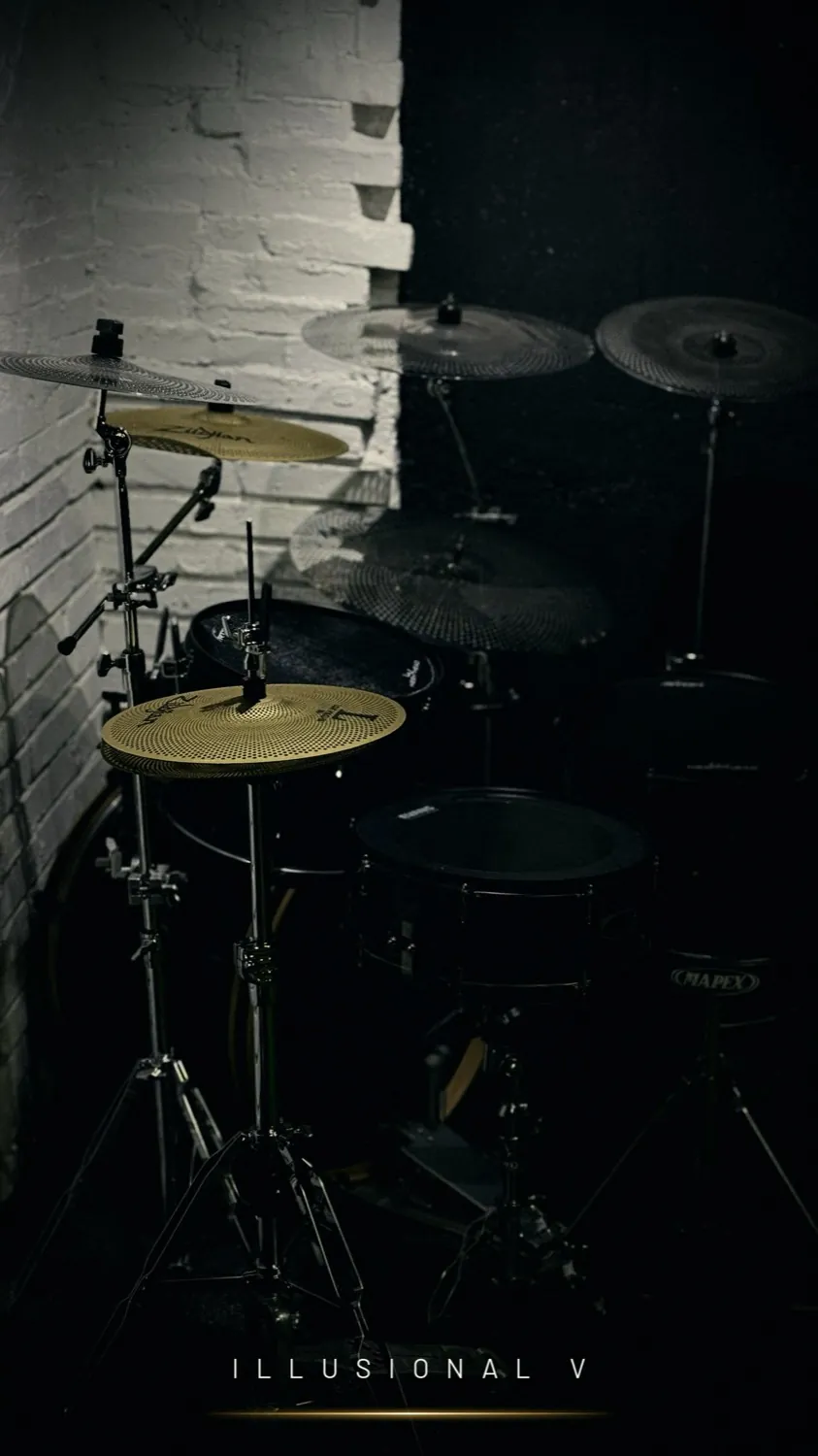
1.1 The idea in one sentence
Keep your real drums, your real hardware and your real throne position — swap out the parts that make noise, and let the computer make the thunder.
That’s a hybrid kit: acoustic drums with electronic triggering. The acoustic shells, pedals and stands stay. Mesh heads and low-volume cymbals cut the acoustic volume. A trigger on every drum sends performance information — which drum, how hard — to the computer, and a drum plugin generates the sound you hear in your headphones. Your neighbours hear tapping. You hear Enter Sandman.
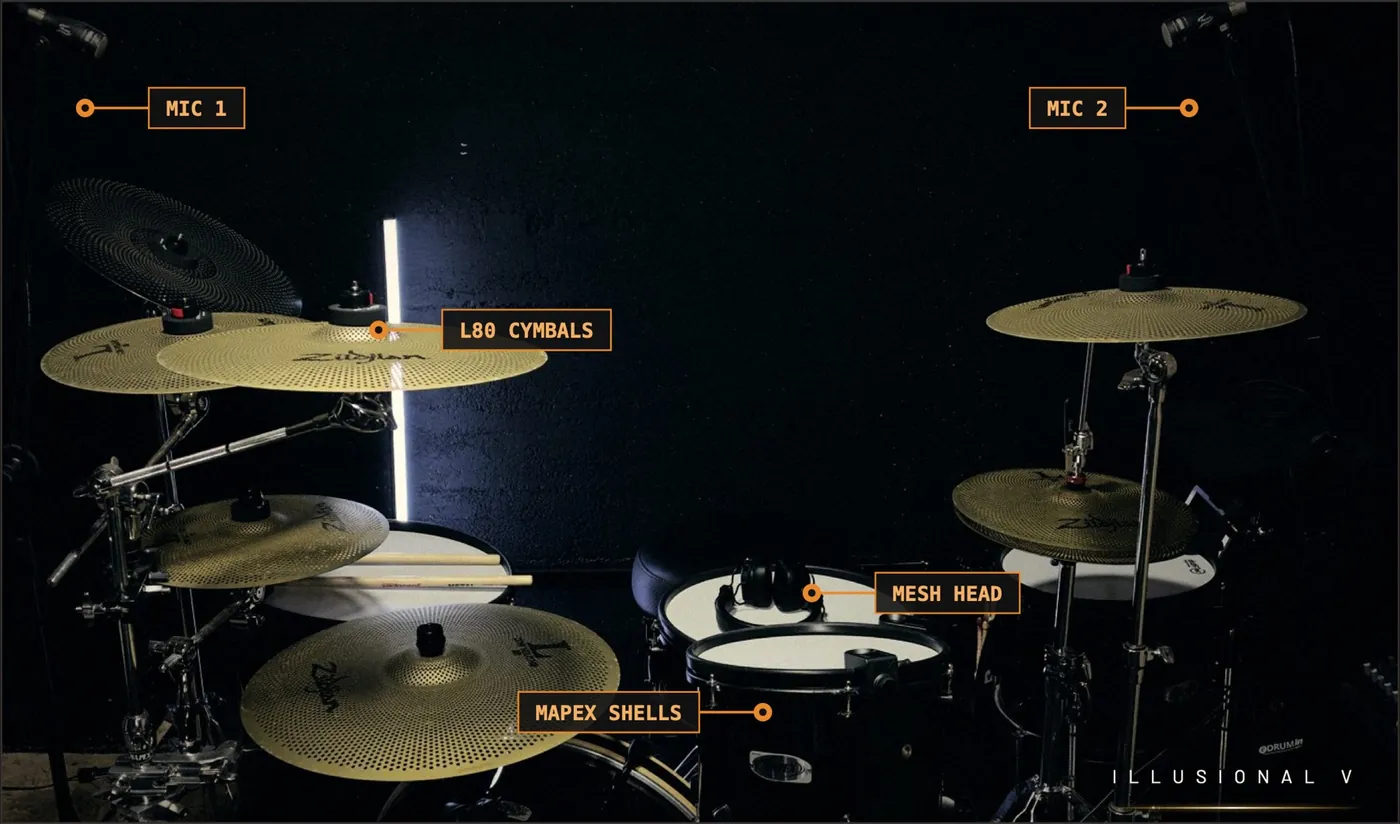
My kit. Mesh heads on every drum, mostly Zildjian L80 cymbals, two dynamic mics on boom stands above the kit — and the same 2008 Mapex shells I’ve always played.
1.2 Why not just buy an e-kit?
Electronic kits and hybrid kits serve different needs. An e-kit is compact, quiet by design and ready out of the box — if space, budget or simplicity matter most, it may be the better choice. If you already own an acoustic kit and want to keep its feel, hybrid has real advantages:
- It’s your kit. Same heights, same angles, same throne. Your muscle memory stays intact.
- Real hardware. Real stands, real pedals, real hi-hat clutch. They move the way drums move.
- Full-size drums. A full-size kick and a real floor tom feel like a kit, not a practice pad on a rack.
- The way back is open. Put normal heads and cymbals back on and it’s a loud rock kit again.
The honest downsides: it takes time to dial in, mesh and low-volume cymbals don’t feel 100% like the real thing, and you need a computer running to hear a good kit sound.
1.3 The whole rig on one page
Two signals travel through this rig, and they never mix until they reach the computer. The triggers send data. The microphones send sound.
Fig. 1 — Lane A carries trigger data as MIDI; Lane B carries microphone audio. They meet in LUNA. The Volt never receives the trigger data: the eDrumin talks to the computer directly over USB.
Key takeaways
- Triggers send data. Mics send sound. Two paths, one mix.
- The eDrumin connects straight to the computer; the Volt handles the mics and your headphones.
1.4 How quiet is quiet?
A lot quieter than a normal kit — but not silent. Know this before you promise anything to your family or your neighbours.
| Source | What you’ll still hear |
|---|---|
| Mesh heads | A soft “tap” from the stick. Very little. |
| Low-volume cymbals | Real cymbal sound, much smaller. Zildjian says its L80s are up to 80% quieter than traditional cymbals. |
| Kick pedal | The real enemy. The beater thump travels through the floor into the room below — double kick even more. |
| Hi-hat and hardware | The “chick” of the hats, pedal squeaks, stands rattling. |
Floors carry impact
Airborne sound — what you hear in the room — drops a lot with this rig. Impact noise is different: every kick stroke and pedal stomp goes straight into the floor, and the building carries it into the rooms below and next door. That’s why the kick is still what other people hear. How much gets through depends on your building, so there’s no honest decibel figure to promise here.
Honest note
If someone lives below you, the kick is what they’ll hear — not the cymbals. A rug helps a little; an isolation riser (a platform that separates the kit from the floor) helps more. Talk to your neighbours before the first double-kick session, not after.
Key takeaways
- Hybrid keeps your drums and swaps only what makes noise.
- Triggers send data. The computer makes the thunder.
- Quiet isn’t silent. The kick pedal is the loudest thing left — and it travels through the floor.